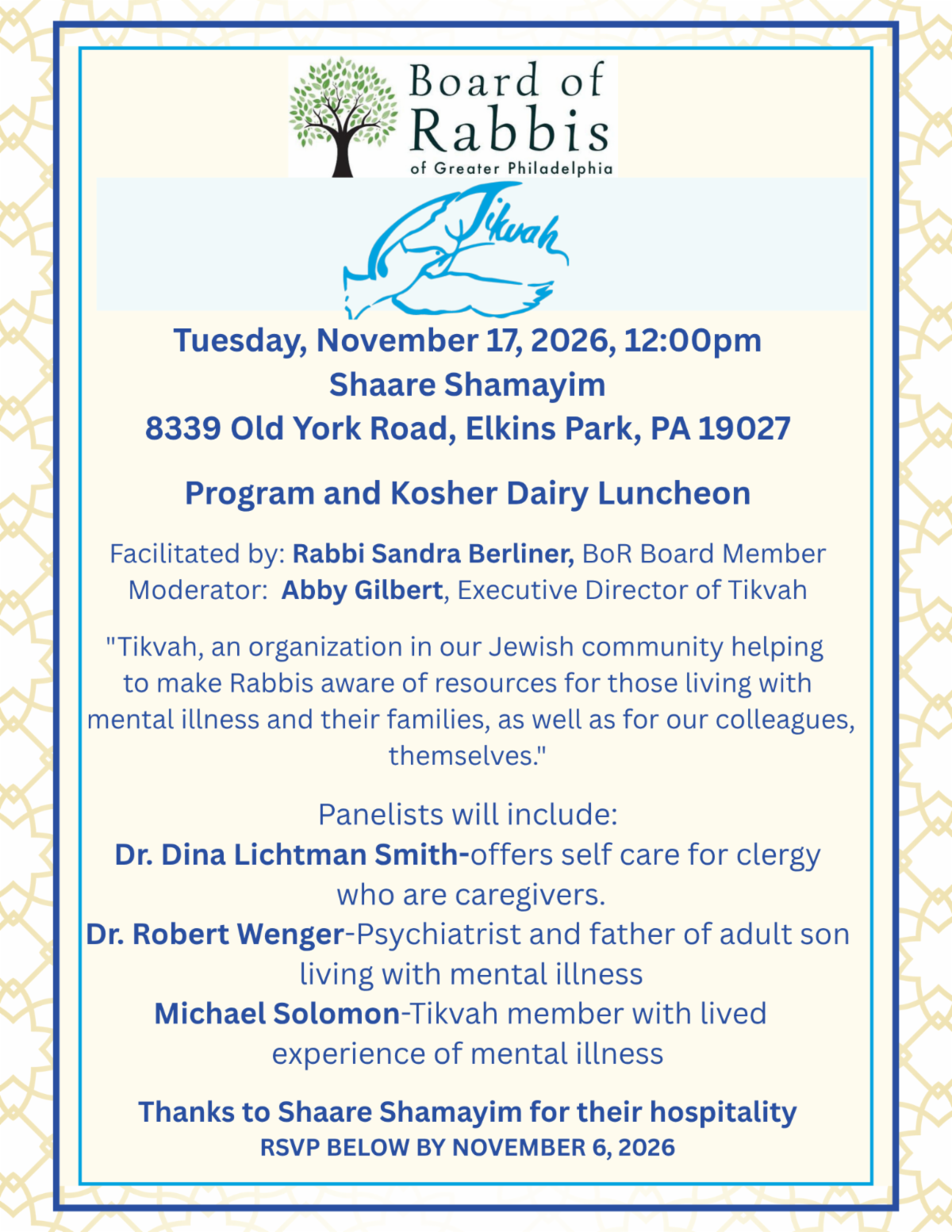
Dear Rabbis,

The Board of Rabbis of Greater Philadelphia is a volunteer-run organization led by rabbis elected as officers and members-at-large who together constitute the Executive Committee of the BOR.

We strive to foster, sustain, and build connections among rabbis who/live work in the Greater Philadelphia area, serve in a variety of professional contexts (including retirement!), and represent a range of rabbinic perspectives. Our connections with one another are precious, and during these challenging times, maintaining and strengthening them take on more urgency and meaning.

To this end, we write now with several announcements. First, we pray for the health and safety of those of you who are attending “A Call to Minneapolis: Faith Leaders Answering History in a Time of Peril and Possibility.” May you go in and return in peace. If you plan to attend, we welcome hearing from you. 

Second, with all the turmoil, hardships and unrest in this country and abroad, we want to remind you of this network, the Board of Rabbis, and invite you to speak with us, share ideas, concerns,

hopes. As we think about how to respond to current events as individuals and members of various communities, we want to facilitate and promote opportunities for learning from and with one another, helping to disseminate information and support.

Yesterday, January 20, 2026, marks 40 years since the first observance of MLK Day as a national holiday. As we honor and remember the incredible life and legacy of Reverend Dr. Martin Luther King, JR., zichrono l’vracha, we hear his call to work together, not give in to despair, to keep moving forward towards our goals with hope, and with the knowledge that our lives are interconnected. No one person can do this alone. We are grateful for this community of rabbis.

 Sincerely,

Rabbi David Levin, President

Rabbi Anna Boswell-Levy, Vice President

Rabbi Erica Steelman, Vice President

Rabbi Lance Sussman, Vice President

Rabbi Eric Mollo, Treasurer

Rabbi Beth Janus, ex-officio Past President

Rabbi David Ackerman, ex-officio Past President

Contributing to a strong, vibrant, and diverse Jewish community in and around Philadelphia

two women and one man standing together and laughing. The man is wearing a kippah

BOR members represent a wide range of professional contexts and rabbinic perspectives.

Amplify Your Voice
a young white woman walking on the street, reading a printed newspaper

Share your ideas with the Greater Philadelphia Jewish community!

Submit a D’var for publication in the Jewish Exponent.

Join Us!

The BOR is comprised of a diverse group of rabbis who live and/or work in the greater Philadelphia region. Our members serve in a wide range of professional contexts and represent a wide range of rabbinic perspectives. The ultimate goal of the BOR is to contribute to a strong, vibrant and diverse Jewish community.
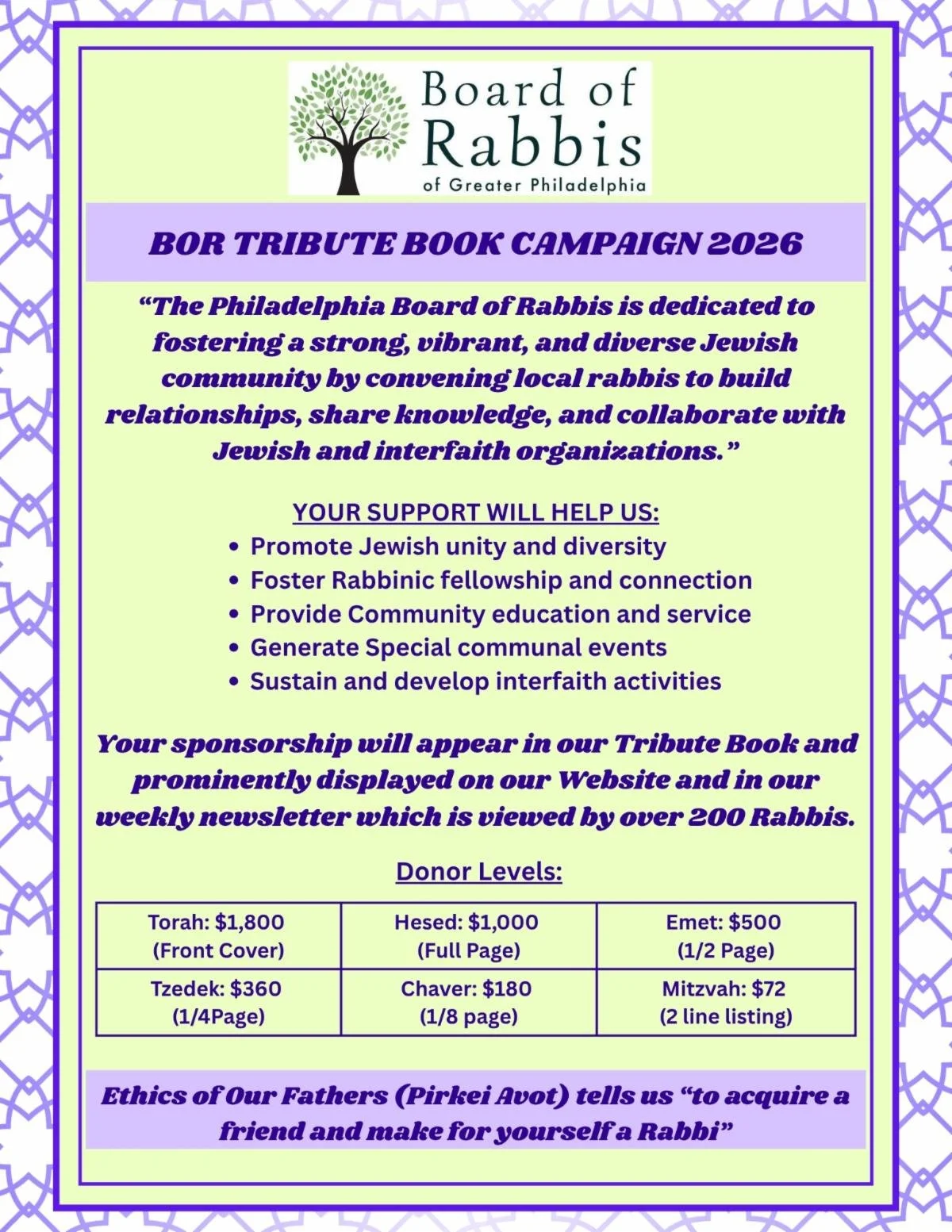
Become A Member Today!

D’var Torah Parshat HaShavuah

Parashat Beshallach 5786

Does God Have an ON/OFF Switch?

Rabbi Eric Yanoff


When my synagogue’s Sanctuary was renovated, we completed the building just under the wire, with finishing touches between Rosh Hashanah and Yom Kippur.  Just before Kol Nidre, we ceremonially “turned on” the Ner Tamid.  I should have been prepared for the question:  Why would the Ner Tamid (the Eternal Light) have a switch?  (In truth, it did not; it only had a dedicated circuit breaker.)  Shouldn’t it just be… ON, all the time, eternally?

Or, more pithily:  Does God have an ON/OFF switch?

It reminds me of a moment in this week’s Torah portion, in which Moses is standing at the edge of a cliff, overlooking the battle between the Israelites and the Amalekites, just after the miraculous crossing at the Sea.  Whenever Moses holds up his hands, Israel prevails; but when his arms grow heavy and fall, Amalek prevails – so Aaron and Hur stand on either side of Moses to support his arms (Exodus 17:10-13).  The midrash asks:  Is it possible that Moses’ arms CAUSED Israel to win or lose in battle?  Mishnah Rosh Hashanah (3:8) answers that it was not Moses’ arms; rather, whenever Israel looked up to the cliff, and saw Moses’ arms, they were reminded of God’s care for them, their spirits were uplifted, and the battle went their way.

God was there the entire time; the Israelites’ ability to win never flagged – but surrounded by a horrific battle, Isarel too easily forgot about God’s Presence.  Immersed in a context, we miss the forest for the trees.

It’s like a classic joke:  Two little fish are swimming off to school, across the big sea, and they encounter an older, bigger fish approaching them, who nods as he swims by, and says, “Good morning boys! how’s the water today?”  The fish smile and nod, and keep on swimming… until, at a distance, one little fish turns to the other little fish and says, “Nice guy – but tell me:  What the heck is water?!

That’s the whole joke.  I’ll wait for you to recover from your laughter – long enough before I explain:  The fish are so immersed in their environs that they don’t even recognize what is all around them. 

Even more absurd, though, is the opposite possible response:  Would it not be even more ridiculous for the fish to be constantly aware of their surroundings?  Imagine us, as humans, gulping at molecules in the air like fish swallow food flakes, constantly appreciative of each molecule, incessantly grateful and purposeful at each gulp! 

 We could not live this way, always stopping ourselves, in awe of each oxygen molecule.  And yet Judaism asks us to strive toward such constant appreciation:  We stop ourselves to say a blessing before food or drink, and when we encounter notable weather or people or circumstances.  Not for each molecule that surrounds us – but yes, we pause to recognize the air or water, the blessings of our daily existence.

For much of our existence, we live, immersed – in a context, perhaps in an echo chamber of how we receive news, how we sculpt our worldviews, taking for granted how we eat and breathe and process and survive and thrive.  Yet such constant immersion is dangerous; there are times when we would do better for ourselves by looking up, with conscious awareness, mindfulness and purpose – to question our assumptions, to see the forest for the trees.

It is true:  We often only recognize our constant, white-noise surroundings when something destabilizes that atmosphere.  Agree or not, recent protests for a broad spectrum of causes have challenged our too-comfortable assumptions…. Hateful statements and acts of violence and disruption intended to shake our sense of safety as Jews in America or as allies of our brothers and sisters in Israel have prompted many to advocate more proudly and firmly for our rights and our Jewish identities.  I often wish we did not need such reminders – but when they come, we dare not miss them.

The Light is firmly “ON” – with no need for a switch.  Like Moses’ raised arms, may we always be inspired to SEE the light, appreciate its power, and thank God for its constancy, which we must never take for granted.